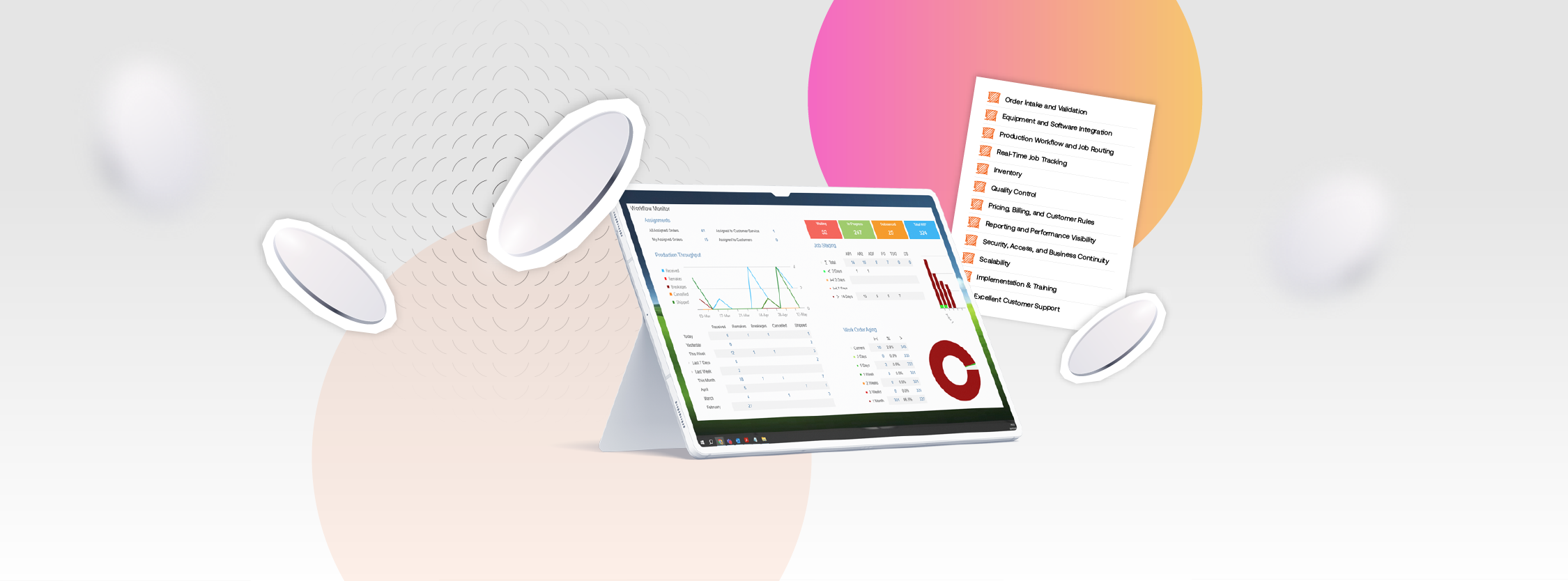
Ocuco and Wink both provide software designed specifically for eyecare businesses. Each brings practice management, clinical records, dispensing, inventory, patient communication, and reporting into one environment.
Wink is framed as professional-grade software that is simple to use. Its offer is divided into tools for practice management, electronic medical records, web ordering, and supplier connectivity. The company places particular emphasis on optician-led onboarding, automated recalls, lab and manufacturer integrations, and features aimed at helping practices get started quickly.
Ocuco’s Acuitas 3 is positioned as a broader clinical and retail platform. It connects scheduling, configurable EMR workflows, dispensing, insurance, inventory, patient communications, and business reporting. It is designed for independent practices as well as larger and multi-location groups.
This comparison uses public information from both vendors and independent software directories. Features, prices, and regional integrations can change, so a demo remains the best way to confirm which system fits your practice.
Ocuco and Wink: Background on Each Platform
Wink Technologies is a Canadian optical software company. Its website says its network serves 3,000 customers. The wider Wink product family includes WINKpms for practice management, WINKemr for clinical records, WINKweb for labs and buying groups, and WINKoms for suppliers and other practice management vendors.
Wink’s messaging is centred on usability and industry knowledge. The company highlights optician-led implementation, access to supplier catalogues, automated communications, cloud delivery, and links with labs, manufacturers, accounting software, insurance providers, and medical equipment. This makes it relevant to opticians, optometrists, buying groups, and optical suppliers, especially in Canada and North America.
Ocuco supports Canadian optical practices through its offices in Burnaby, near Vancouver, and Toronto, backed by more than 30 years of experience developing software exclusively for the eyecare industry. Acuitas 3 is also built for opticians and optometrists, supporting independent practices, clinics, optical groups, and enterprise-level chains, from smaller multi-location operators to large retail networks, with connected clinical and retail workflows.. For Canadian users, Ocuco describes Acuitas 3 as an all-in-one system with provincial billing support, integrated point of sale, customisable clinical workflows, validated dispensing, lab connections, real-time stock control, and North American support.
The platforms therefore overlap significantly, but their public positioning starts in a different place. Wink leads with ease of adoption and practical connections to the optical supply chain. Acuitas 3 leads with an integrated patient journey, configurable workflows, governance, and the ability to manage more complex operations from one platform. It is also backed by published security credentials for Acuitas 3 OmniChannel Edition, including ISO/IEC 27001:2017 certification and SOC 2 Type II certification.
Ocuco vs Wink at a Glance
| Area | Acuitas 3 | Wink |
|---|---|---|
| Best suited to | Eyecare businesses that want a cloud-based platform with configurable workflows, validated dispensing, and Power BI reporting to support growth and operational complexity. | Practices that want a cloud suite with a strong emphasis on supplier catalogues, ordering workflows, and optician‑led implementation. |
| EMR and scheduling | Customisable EMR with unified online and in-practice scheduling, plus built‑in recalls and email/SMS appointment reminders, with CRM tools to support targeted recall and marketing campaigns | Cloud EMR, appointment calendar, reminders, and online booking, ; email and SMS appointment reminders/confirmations are available by plan |
| Dispensing and inventory | Validated dispensing, supplier and lab ordering, product catalogue management, and real-time multi-site stock control | Dispensing, supplier ordering, catalogues, and stock management |
| Reporting | Power BI dashboards and multi-location KPI tracking | Sales, inventory, accounting, and payroll-oriented reporting (by plan) |
| Multi-location use | Centralised workflows, data, stock, and reporting | Shared database, catalogues, pricing, and location permissions |
| Pricing | Quote based, tailored to practice requirements | Four plans are listed, but current prices are not published on Wink’s website |
Compiled from public vendor information available at the time of writing. Confirm plan availability, integrations, compliance requirements, and total cost directly with each vendor.
Pricing and Total Cost
Pricing isn’t just the monthly subscription. Data migration, onboarding, training, support, storage, equipment connections, additional locations, and optional modules can all change the total cost.
Ocuco uses quote-based pricing. The final price depends on the size of the practice, the number of locations and users, the required modules, and the complexity of implementation. A tailored quote makes it possible to cost the system around the practice, but it also means buyers need a detailed scope before they can compare offers fairly. Ocuco’s approach also allows implementation, training, integrations, and ongoing support to be scoped around each practice’s requirements. Acuitas 3 customers can contact Ocuco’s support team by phone or email, or create, update, and track support tickets online, giving practices a choice of direct and self-service support channels.
Wink lists four packages: Starter Suite, Business Essentials, Medical Practice, and Medical Enterprise. Its website explains which features sit in each plan but does not currently show plan prices. Independent directories such as Capterra and Software Advice list a starting price of CA$100 per user per month. Because this figure does not appear on Wink’s own plan page, practices should treat it as indicative and request a current written quote.
Wink’s plan structure also matters. EMR is shown in the Medical Practice and Medical Enterprise tiers, while features such as a non-retail location licence, extra storage, and some custom integration maintenance may be add-ons. Telephone support is not included in the basic web-support offer and may be charged separately, according to Wink’s plan information.
For a useful comparison, ask both vendors for a three-year cost that includes implementation, migration, training, support, integrations, messaging, storage, and every location. This avoids comparing one vendor’s base subscription with the other’s complete deployment.
Clinical Records and the Patient Journey
WINKemr is a private, cloud-based clinical record for iPad and desktop use. It gives optometrists access to consultation data, previous visits, prescriptions, health information, graphs, referral letters, and recommendations for the dispensary. It also supports dictation, Apple Pencil notes, uploaded images, and two-way device integration. A patient portal can give patients access to selected invoices, prescriptions, appointments, and preliminary forms.
Acuitas 3 also combines EMR and practice management, but places more emphasis on configurable clinical workflows. Practices can adapt documentation to different appointment and examination types, while the patient record remains connected to scheduling, dispensing, stock, billing, recalls, and online interactions. Acuitas 3 also supports integrations with clinical equipment, enabling retrieval of readings within the platform.
This distinction is worth testing in a demo. If iPad-based clinical entry is important to your team, it’s worth seeing Wink’s iPad workflow in action. A clinic with several consultation types, more detailed documentation rules, or a need to standardise processes across clinicians and locations may benefit from the configurable workflows in Ocuco’s connected EMR and practice platform.
Dispensing, Inventory, and Supplier Connections
Wink emphasises supplier connectivity and ordering workflows in its messaging.. Its software can provide access to lens, frame, and contact lens catalogues, send orders to manufacturers, display job status, and return invoice details. WINKoms extends that expertise as middleware for other software providers that want to connect with optical suppliers. Its published features also cover stock receiving, returns, transfers, audits, and reporting.
Acuitas 3 connects frame and lens selection, measurements, orders, inventory, and lab communication. Its validated dispensing process checks whether a selected frame and lens combination can be produced before the order is submitted. That is designed to identify problems earlier and reduce avoidable remakes. Real-time stock information and reorder automation can also be managed across the business. Acuitas 3 also supports a broad ecosystem of partners and integrations across suppliers, software providers, and clinical instrumentation (availability varies by region and should be confirmed during a demo).
Both platforms therefore offer more than general retail inventory. The deciding factor will often be the exact suppliers, labs, devices, and catalogues a practice uses. Ask each vendor to demonstrate a complete order using your preferred lab, including feasibility checks, price updates, job tracking, redos, and invoice reconciliation.
Scheduling and Patient Communication
Wink provides appointment booking, waiting-list management, automated recalls, confirmations, and messages to tell patients that eyewear is ready for collection. Its basic email and SMS functions appear across the four published plans, while Mailchimp integration and premium marketing messages are available on selected higher tiers.
Acuitas 3 links online and in-practice appointments in one schedule. Automated recalls, appointment reminders, email marketing, and CRM tools operate alongside the wider patient record. Its omnichannel design is intended to maintain one view of patient interactions across digital and in-practice touchpoints.
The practical questions are less about whether both systems can send a reminder and more about control. Can staff build different recall journeys by patient type? Can they see consent and communication history in one place? Can campaign results be compared across locations? Can patients complete part of the process online without creating duplicate records? These details determine how much administrative work the system actually removes.
Reporting and Management Visibility
Wink promotes reporting across core practice and retail activity (including sales, inventory, and accounting-related reporting). On eligible plans, it also includes a punch clock and payroll-oriented reporting, which may appeal to practices that want staff time and retail activity in the same system.
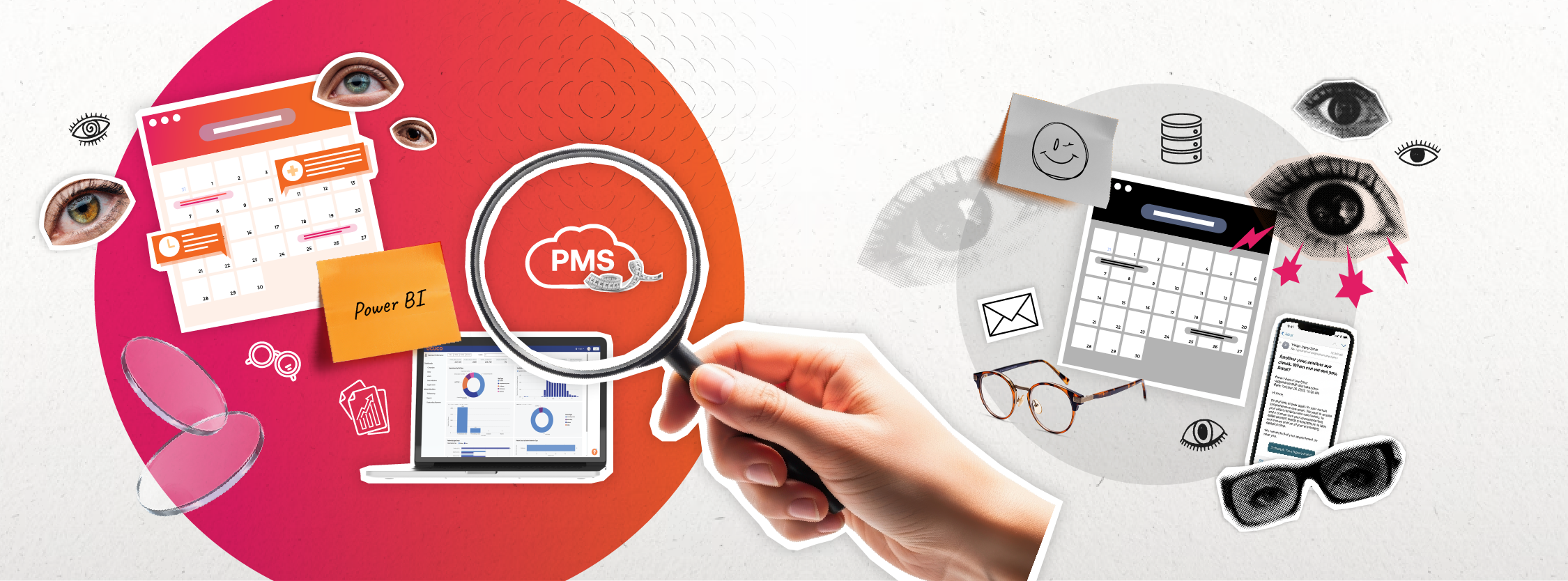
Acuitas 3 uses Microsoft Power BI for visual dashboards and KPI reporting. Practices can analyse areas such as appointments, sales, inventory, and overall practice performance, and use dashboards to support management visibility across the business.. Its centralised model is intended to give owners and managers a consistent view across the practice rather than a collection of separate operational reports.
When comparing reporting, the goal isn’t just “more reports,” but clearer answers to the questions you manage.
| Reporting question | Why it matters |
|---|---|
| Can the dashboard be changed without vendor assistance? | Fixed reports may not answer the questions your practice asks each month. |
| Can results be filtered by clinician, location, product category, and period? | Detailed filters make it easier to identify the cause of a trend. |
| Does the system connect appointments, clinical activity, sales, and stock? | Joined-up data provides a more complete view of performance. |
| Can reports be scheduled, exported, and shared with appropriate permissions? | Managers need regular access without exposing unnecessary patient or financial data. |
| Are definitions consistent across every location? | Shared KPI definitions prevent different sites from reporting the same measure differently. |
For smaller teams, Wink’s range of built-in operational reporting and staff-time tools (by plan) may cover the immediate need. As a practice grows, connecting reporting with day-to-day optical practice management can make it easier to analyse performance across appointments, sales, inventory, and staff.
Multi-Location Management and Growth
Both vendors state that they support more than one location. Wink offers a single database for multiple stores or clinics, central management of catalogues and pricing, shared patient information, and permissions that can restrict access by location. It also lists a separate non-retail location licence for central inventory or head-office functions as an add-on.
Acuitas 3 is designed to centralise patient information, stock, reporting, permissions, and workflows across independent practices and larger groups. Its focus is not only shared access but also consistent clinical and commercial processes across locations. Acuitas 3 is used by both independent practices and large optical chains.
A growing practice should look beyond whether another site can be added with ease. Ask how pricing changes, whether data remains in one database, how access rights work, whether stock can move between locations, and whether head office can update workflows, catalogues, and reports centrally. The cost and effort of adding the third or tenth location may be more revealing than the setup for the first.
Security, Hosting, and Reliability
Clinical and payment data make security a central buying requirement. Acuitas 3 is backed by ISO 27001-certified practices and SOC 2 Type II certification, alongside PIPEDA, HIPPA, GDPR and DPA compliance. It also highlights audit trails and traceability across system activity. These documented controls may be important to practices with formal governance, insurer, partner, or multi-location requirements.
Wink maintains a public Trust Center describing its privacy and security commitments, stating compliance with privacy laws including HIPAA, GDPR, and PIPEDA, and referencing privacy standards such as ISO 27001. In addition, Wink’s plans include multi-factor authentication, and Wink states a 99.5% uptime guarantee for its cloud servers.
Ask both vendors where data is stored, how it is encrypted, how often backups are tested, how access is logged, what happens during an outage, and how data can be exported when the contract ends. Canadian practices should also confirm how the system supports the privacy and health-information rules that apply in their province.
Implementation, Training, and Support
Wink highlights onboarding and implementation in its published materials. It says it will configure the database, upload practice data, train staff, assign an account manager, and provide support through web resources, email, chat, and, depending on the support arrangement, telephone. Its description of optician-led implementation reinforces its positioning as an approachable industry specialist.
Ocuco positions EHR implementation as a structured, guided process that typically includes data migration, configuration, onboarding, and role-based training. In Ocuco’s published implementation guidance, data is migrated into a test system for validation before training and go-live are scheduled. After go-live, Ocuco notes that its implementation and training team can remain closely engaged to help teams settle in, answer questions, and resolve issues as they arise. This approach can be particularly relevant for practices with more complex configurations, integrations, or multi-site requirements. Support is only a phone call away. Ocuco also provides support via email and through its online support portal, where customers can create, update, and track support tickets.
Ease of use cannot be judged from a feature list. Ask reception, clinical, dispensing, and management staff to complete their own common tasks during each demo. Also request a migration plan that explains who owns data mapping, how accuracy will be checked, what training each role receives, and who will be available during go-live.
Which Practices Are Best Suited to Wink?
Wink may be a strong fit for optical businesses that value:
- A platform presented around ease of use and straightforward adoption
- Optician-led onboarding and training
- Direct connections to labs, frame suppliers, contact lens manufacturers, and equipment
- iPad-friendly EMR entry and a patient portal
- Operational reports covering sales, staff, commissions, stock, and profitability
- A tiered plan structure that lets the practice choose its required level of clinical functionality
Which Practices Are Best Suited to Ocuco Acuitas 3?
Acuitas 3 is a configurable, end-to-end platform that can adapt to how practices operate today and scale as they grow, including across multiple locations. It’s a strong fit for practices that want:
- Configurable clinical workflows for different appointment and examination types
- One connected process from booking and EMR through dispensing, payment, recall, and reporting
- Validated dispensing and deeper control of frame, lens, lab, and stock workflows
- Power BI dashboards and centralised performance reporting
- Documented security standards, audit trails, and formal compliance support
- A platform that can support increasing operational complexity without separating clinical and retail data
The system is not limited to larger groups. A single-site practice may choose it because it wants stronger clinical configuration, reporting, or a platform that can expand without a later replacement.
Questions to Ask During Both Demos
Search and optical software-buying discussions consistently return to the same practical concerns: usability, complete cost, data migration, support, integrations, reliability, and the ability to grow. Bring the same workflow and questions to both demonstrations:
- Can you show a full patient journey, from online booking to examination, dispensing, payment, lab order, and recall?
- Which of our diagnostic devices, insurers, labs, accounting tools, and suppliers are already integrated?
- Which features in the demonstration are included in our quoted plan, and which cost extra?
- Who migrates our data, how is it validated, and what information may not transfer?
- What are the support hours, response targets, escalation process, and charges?
- Where is our data stored, which security audits can you share, and how do we export the data if we leave?
Ocuco vs Wink: The Final Decision
Wink and Ocuco both cover the core requirements of a modern eyecare practice, but they are likely to appeal for different reasons. Wink’s clear strengths are its usability-led positioning, optician-led onboarding, iPad EMR, supplier connectivity, and practical operational tools. Acuitas 3 stands out for configurable clinical workflows, validated dispensing, connected online and in-practice journeys, advanced reporting, published security credentials, and centralised management at scale.
The right choice depends on the workflows your team needs today and the complexity you expect over the next several years. Compare complete quotes, (including implementation, training, support, integrations, messaging, storage, and every location), and ask both vendors to demonstrate the same real-world patient journey end to end, then confirm the exact integrations you rely on in writing.
For practices looking for a secure platform that connects clinical care, optical retail, and business management, book a tailored Acuitas 3 demo to see how the system would work with your current setup.