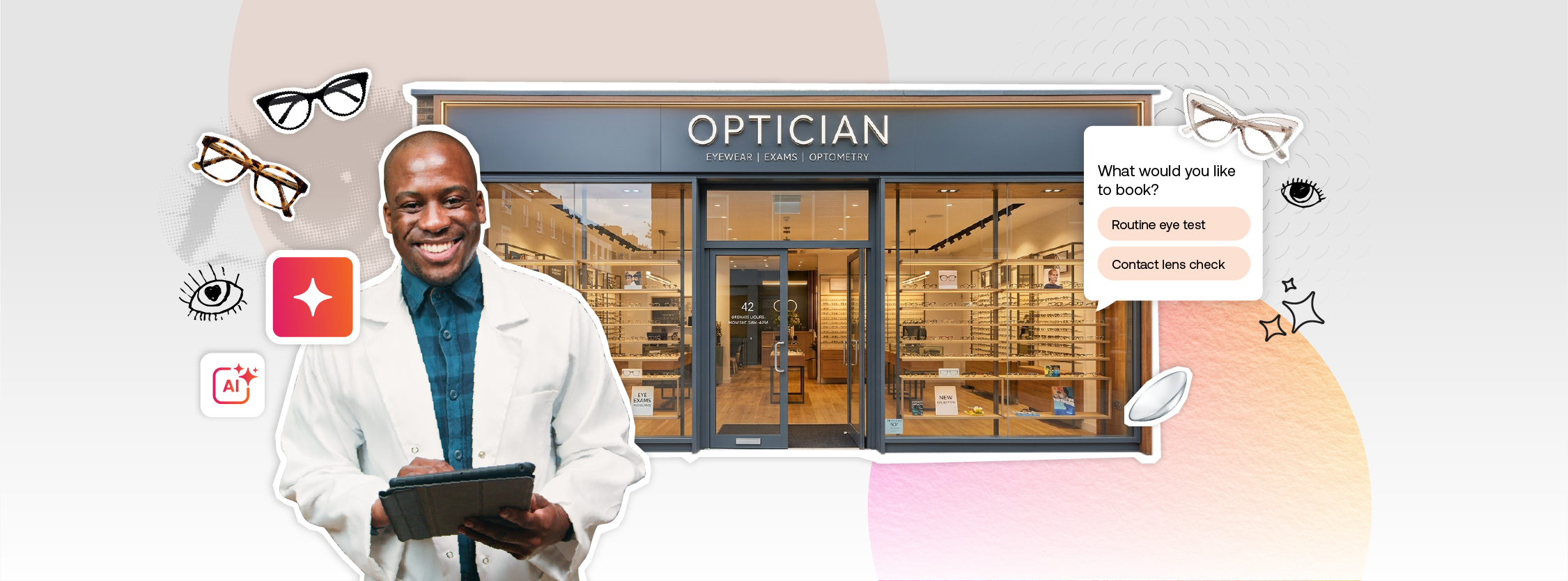
Online eyewear retailers have built their businesses around convenience. Customers can browse hundreds of frames, get suggestions based on their preferences and place an order without leaving home.
Independent optical practices have their own clear advantages. They offer clinical expertise, professional fitting, local knowledge and relationships that often last for years. The challenge is making these benefits as easy to access as an online eyewear store.
AI can help practices make that happen. It can speed up responses, make patient communication more relevant and support a smoother digital experience. Some tools answer routine questions; others can take agreed actions, such as offering a cancelled appointment to a patient on the waiting list. These capabilities depend on the tool, its access to accurate practice information and the rules the practice sets. At the same time, practices can keep the personal service that sets them apart.
Competing on Convenience Without Competing on Price
Large online retailers may be able to offer lower prices through economies. For many independent practices, trying to win a price war is neither realistic nor necessary.
Patients do not choose eyewear based on price alone. They also care about fit, comfort, lens quality, professional advice and what happens when something needs adjusting. These are areas where an independent practice already has an advantage.
The problem is that patients may never reach that point if booking is difficult, questions go unanswered or the website does not make it easy to explore their options.
A clear website, online booking and timely responses can help practices remove this early friction. AI can build on that foundation by answering routine questions using practice-approved information, suggesting relevant products for professional review and, where integrated with the practice diary, offering available appointments within rules set by the practice.
A patient can receive the speed they expect online, followed by the personal care they value in the practice.
1. Helping Patients Find the Right Frames Faster
Online eyewear stores make it easy to narrow down the options. Customers can sort frames by shape, colour, material, price and size in just a few seconds. In a practice, that same customer may be looking at a wall of frames without knowing where to begin.
AI can make the choice feel less overwhelming. Where it has access to relevant, accurate information, such as the patient’s prescription, past purchases, budget and style preferences, the system can reduce a large collection to a shorter list of suitable frames. Tools designed to account for prescription and lens requirements can also help flag options that need closer consideration. The dispensing team still needs to assess their suitability.
The technology does not replace the conversation with the optician. It simply gives that conversation a clearer and more useful starting point.
The optician can spend less time looking through frames that are unlikely to work. This leaves more time to talk about fit, comfort, lens performance and the patient’s personal style. The patient still benefits from professional advice, while the whole process can become quicker, easier and more focused.
Virtual try-on tools can continue the experience outside the practice. Patients can look at frames from home, save the styles they like and visit the practice with a better idea of what they want. Virtual try-on helps patients explore appearance; it does not confirm physical fit or prescription suitability. If the system is connected, the dispensing team can view those saved choices and help the patient make the final decision.
This can create a smoother link between online browsing and in-practice care, which is central to an effective digital journey for optical patients.
2. Making the Practice Available Outside Opening Hours
Online retailers allow customers to browse and order at any time. Independent practices do, but that does not mean their digital service needs to stop at the end of the day.
A patient visiting a website in the evening may want to know whether the practice stocks a particular brand, accepts their insurance or voucher, offers children’s appointments or can provide a specific lens option.
An AI assistant can answer routine questions immediately using information approved by the practice. If the question is clinical, urgent or too complex, it can direct the patient to the right person instead of attempting to answer it.
The difference between a useful assistant and a frustrating chatbot is what happens when it reaches its limits. Patients should always know when they are speaking to an automated system and how to contact a member of staff.
When it is set up properly, and its information is kept up to date, the assistant can give patients quick answers while reducing the number of repeat questions the team handles each morning.
3. Turning Interest Into Booked Appointments
A well-designed website is useful, but it needs to make it easy for visitors to take the next step. That might mean booking an appointment, asking a question or contacting the practice for more information.
Website analytics can help identify where people leave the booking process and which pages lead to bookings. Reviewing those patterns alongside patient enquiries can help the practice identify unclear appointment descriptions or navigations. AI can help interpret these patterns and highlight opportunities to improve the booking journey. The practice can then give people more helpful prompts based on the page they are viewing and the service they need.
For example, someone reading about children’s eye examinations should have a clear link to the correct appointment. A contact lens wearer should be able to find the right booking option without searching through services that do not apply to them.
The booking process should also be quick and easy to follow. Patients need to see available times, select the correct appointment and receive confirmation without having to call the practice.
When online booking is connected to the practice diary, an AI assistant with the appropriate integration and permissions AI can provide further support. It can spot a cancellation, find suitable patients on the waiting list and offer the available time directly,following rules set by the practice for appointment type, duration and practitioner availability. This canhelp patients book sooner and reduce the time staff spend trying to fill empty slots.
For example:
“We have an eye examination available on Thursday at 2:15. Would you like us to reserve it for you?”
The patient’s response should feed back into the booking system, with availability checked before the appointment is confirmed.
That is easier to act on than a general message asking the patient to visit the website and search for a time.
Practices reviewing this part of the experience can start with the principles behind a smoother online appointment process.
4. Personalising Follow-Up Without Adding More Admin
Online retailers are good at following up. They remind customers about saved products, unfinished orders and items they may want to buy again.
Independent practices hold information relevant to ongoing patient care, including prescription history, appointment records, previous eyewear choices and recall dates. Used carefully, this information can support much more relevant communication.
AI can help group patients according to their genuine needs and purchase history, rather than sending the same message to everyone.
A patient whose eye examination is overdue might receive a proposed appointment based on current availability. Someone who recently bought glasses could receive a collection update followed by care advice. A contact lens wearer may receive a reorder reminder based on their normal supply cycle. Collection updates should reflect confirmed order status, and care advice should use content approved by the practice.
The practice still decides who can be contacted, what information can be used and which messages require staff approval. These decisions should account for the purpose of the message, patient preferences and applicable data protection and marketing requirements. AI can support the repetitive work within those rules.
The result can be communication that feels timely and personal without requiring the team to work through lists manually every week.
5. Giving Staff Better Information During the Sale
Online retailers use data to understand what customers view, compare and buy. Independent practices can use their own data to make better decisions about stock, dispensing and patient follow-up.
AI-supported reporting can help teams interpret patterns in practice data and highlight:
- Frames that sell quickly and may need reordering
- Products that have remained unsold for too long
- Popular combinations of frames, lenses and coatings
- Appointment types that often lead to eyewear purchases
- Patients who are due for a recall but have not booked
- Differences between online interest and in-practice sales where those records can be reliably linked
This information can help the team make practical decisions. Buyers can order with more confidence. Dispensing staff can understand which ranges work for different patient groups, while assessing suitability for each individual. Practice managers can see where sales opportunities may be missed..
Better reporting does not mean handing every decision to an algorithm. It means giving the team a clearer view of what is happening. AI can add value by drawing attention to patterns and suggesting areas to investigate, with staff reviewing those suggestions against their knowledge of the practice.
For independents, that matters. Slow-moving frames tie up cash and display space. Reviewing sales trends alongside current stock, supplier lead times and patient demand can help the practice make more informed purchasing decisions.Better control of optical stock and product performance can reduce unnecessary purchasing and free up cash tied to slow-moving inventory.
6. Connecting Online Shopping With In-Practice Care
Patients do not always think in separate online and offline channels. They may discover a frame on their phone, book an eye test on a laptop, visit the practice for advice and complete the purchase later from home.
If those stages are disconnected, the patient may have to repeat information or retrace their choices each time.
A connected platform can carry useful information between them, depending on how the website, eCommerce and practice management systems are integrated. Saved frames can appear during the dispensing appointment. Current stock can be reflected on the website. An online purchase can be added to the patient record. Click-and-collect can bring the patient into the practice for a final fitting and adjustment.
AI can support this journey by recommending the next useful action based on relevant information and rules set by the practice. That might be booking an eye examination, arranging a fitting or asking the practice for advice about a complex prescription.
This gives independent practices a way to combine digital convenience with in-person expertise. Patients receive digital convenience when they want it and professional support when they need it.
The aim is to make online eyewear shopping feel personal instead of treating eCommerce as a separate part of the business.
7. Protecting the Human Advantage
AI is most useful when it creates more time for the parts of optical care that require a person.
It can narrow a frame selection, but the dispensing conversation is still needed to understand how the patient feels wearing those frames. It can prepare a lens comparison, but the optician still needs to explain the trade-offs. It can send a recall message, but it cannot replace the trust built over years of care.
Independent practices should use AI to remove repetitive work around the patient relationship, not the relationship itself.
That means keeping clear boundaries:
- Clinical decisions remain with qualified professionals.
- Product recommendations are checked by the dispensing team.
- Patient data is processed only through systems approved by the practice, with clear controls over access, storage and use.
- Automated messages follow applicable consent and communication rules.
- Staff can review what the system did and why.
- Patients can reach a person when they need help.
- The practice defines which actions AI can take independently and which require staff approval.
The strongest approach combines intelligent tools with a connected practice management system for independent opticians. When booking, patient records, inventory, dispensing and communication share accurate information, AI can provide more relevant support within the boundaries the practice sets..
What This Looks Like in Practice
The competitive advantage is not one dramatic AI feature. It is a series of small improvements across the patient journey.
The examples below show how digital services, connected systems and AI support can help an independent practice respond to the convenience patients expect online.
| Online retailer advantage | How an independent practice can respond |
| Shopping available at any time | Online booking, product browsing and automated answers to routine questions outside opening hours |
| Large product catalogue | Personalised frame shortlists based on fit, prescription, style and budget |
| Fast recommendations | AI-supported suggestions reviewed by an optical professional |
| Automated follow-up | Relevant recall, collection and reorder messages based on accurate records and practice-approved rules |
| Simple digital purchasing | Connected eCommerce, click-and-collect and in-practice fitting |
| Data-driven merchandising | Clear reporting on sales, stock movement and patient demand, with AI helping staff interpret patterns |
| Convenient self-service | Digital tools with an easy route to a real person |
Online retailers are strong where the journey is predictable. Independent practices are strongest where the patient needs expertise, reassurance or a solution designed around them.
Compete on What Makes the Practice Valuable
Independent practices do not need to become technology companies to compete online. They need technology that removes friction and makes their existing strengths easier to experience.
A convenient booking process helps patients arrange a visit. Better recommendations make the frame search easier. Connected records give the team useful context. Automated follow-up helps maintain contact after the visit. AI can build on this foundation by interpreting relevant information and taking agreed actions within rules set by the practice.
Behind all of it, the patient still has access to qualified professionals who can examine their eyes, understand their prescription, fit their eyewear and help when something does not feel right.
Combining that expertise with digital convenience gives patients a practical reason to choose an independent practice.
AI can make an independent practice faster and easier to deal with. The people inside it remain central to the care and service patients receive.
Want to connect booking, patient communication, inventory and eCommerce in one optical platform? Book a demo to see how it fits your practice.