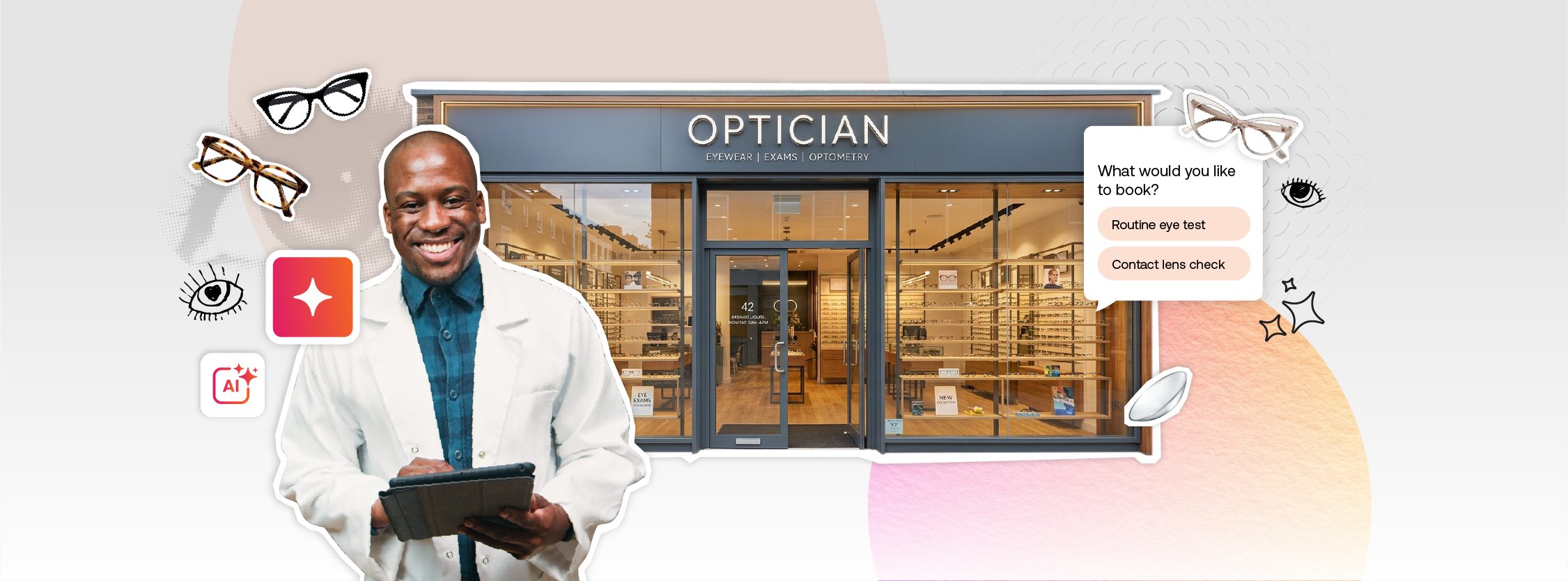
Most optical practices already use some AI: a chatbot on the website, online booking, automated reminders. Useful, but hardly new. Patients now expect them the way they expect a car park.
The real change is one level down. AI is moving from answering questions to getting things done: filling a gap in Thursday’s diary, offering an overdue patient a slot, writing up the exam while the optometrist talks to the patient. Same team, far less chasing.
This article walks through the optical patient journey stage by stage and covers the part most articles skip: how to do it without putting patient data or clinical judgement at risk.
Two Kinds of AI, and Why the Difference Matters
AI that answers. A patient asks, the system responds. Chatbots, search, recommendations. Helpful, but it waits to be asked.
AI that acts. The system notices something and does the work, within rules you set. It sees a cancellation and rebooks the slot from the waitlist. It sees an overdue patient and proposes an appointment. Nobody had to ask.
The first kind makes your practice easier to deal with. The second kind gives your team their week back.
The Patient Journey, Stage by Stage
The journey runs: find optical practice, ask a question, book, get reminded, attend the exam, choose eyewear, pay, come back to pick up the eyewear when it’s ready and then return for the next eye exam after 1 or 2 years. Friction shows up at every stage, for patients and for staff. Here is where AI changes each one.
1. Finding You and Asking Questions
A patient searching at 9pm wants opening hours, prices, whether you take their voucher or insurance, and whether they can bring their child. A well-set-up chatbot answers all of that and hands anything clinical to a person. Table stakes now. The one rule that still matters: make it obvious the bot provides no medical advice and gives urgent cases a fast route to a human.
2. Booking: From “Book Online” to a Diary That Fills Itself
Online booking solved half the problem: patients who want an appointment can take one without calling. It does nothing about the other half: the slots nobody books, the Tuesday afternoon that empties after two cancellations, the hundreds of recall patients who never quite get round to it.
This is where AI that acts earns its keep. Picture an assistant that watches your diary all day. When a gap appears, it works down a list you control: waitlist first, then cancelled patients needing a rebook, then recalls due, then overdue. It texts or emails a specific offer, “We have Thursday at 2.15 with Sarah, shall I book it?”, and one tap confirms. Your team sees the slot filled, not the forty messages it took.
Recall works the same way. Instead of a generic “you are due for an eye test” letter, each patient gets a personal message with a real-time already picked. A proposal is far easier to say yes to than an instruction to go and find a slot. And because it runs through your existing online booking system, nothing gets double-booked.
⇒ What it feels like for the practice manager: you stop opening the diary each morning to look for holes. The holes are already being worked on.
3. Reminders That Say the Right Thing
Most reminders are identical whether the patient is collecting glasses or bringing a child for a myopia assessment. AI can tailor the message to the appointment: what to bring, how long it takes, whether to wear contact lenses that morning. It can time the nudge for people who tend to forget and make rescheduling one link instead of a call. Fewer surprises, fewer no-shows, and when someone does cancel, the slot goes straight back to the assistant in step 2.
4. In the Exam Room
An eye exam generates a lot of typing. The emerging role for AI here is not diagnosis but note-taking: the clinician talks through findings as they normally would, and the system fills in the structured record for them to check and sign. Clinicians get their eye contact back. Anything of this kind is reviewed before it is saved and is subject to medical device rules where they apply. Expect it to arrive carefully, not overnight.
5. Choosing Eyewear
With a fresh prescription in hand, AI can do something a website cannot: shortlist frames that are actually in stock, suit the prescription, fit the budget and match the style the patient showed interest in online. Instead of a wall of 600 frames, the dispensing conversation starts with eight good ones.
Lenses follow the same logic. Using the prescription, the patient’s age, their work and screen time, AI can narrow lens options and coatings to a sensible few, with reasons in plain English. The optician still recommends and fits. They just spend less time explaining what a high-index lens is and more time on the patient.

6. After the Visit
Recall is where practices leak revenue and patients drift away. The assistant from step 2 closes the loop: when a patient falls due it sends an appointment to accept, not a reminder to book. If they ignore it, it tries again at a sensible interval, then flags them for a human follow-up. Your recall rate stops depending on whoever had time to run the list that month.
What Patient Journey Problems Can AI Solve?
| The problem | What AI does | What it means for you |
|---|---|---|
| Questions arrive out of hours | Chatbot answers routine queries, hands clinical ones to staff | Fewer repeat calls, patients get answers when they want them |
| Gaps and cancellations in the diary | Watches the diary and offers open slots to the right patients, in priority order | Diary fills itself; staff stop chasing |
| Recall letters that nobody acts on | Sends a personal message with a specific slot to accept in one tap | Higher recall response, more patients retained |
| No-shows and forgotten prep | Reminders tailored to the appointment, with one-link rescheduling | Fewer empty chairs, fewer wasted slots |
| Typing during the exam | Drafts structured notes from the clinician’s dictation for review | More eye contact, less admin after hours |
| 600 frames, no starting point | Curated shortlist of in-stock frames matched to prescription, budget and style | Shorter, more confident dispensing |
| Confusing lens choices | Narrows options using prescription and lifestyle, explains why | Clearer conversation, better fit |
Security, Guardrails and Data Protection
Patient records are among the most sensitive data a small business holds. An AI tool that touches them is a new door into your practice, and a leak would cost far more than any efficiency gain is worth. Before you switch anything on, four things need to be true.
- Your data stays yours. Patient information stays in your practice management system and is never pasted into a public chatbot. Any AI feature processes it in a controlled environment, under a contract that says it is not used to train anyone else’s model, in line with UK GDPR, EU GDPR or HIPAA depending on where you practice.
- The AI acts within limits you set. A diary assistant only contacts patients you have included, in the order you decide, at the hours you allow, and waits for a cooling-off period after cancellation. It never deletes anything, changes a price or sends a clinical message on its own.
- A person stays in charge. Anything clinical is reviewed and signed by the clinician. Anything that changes records in bulk is approved by a person first. New tools run silently for a trial period so you can see what they would have done before they do it.
- Everything is traceable. You can see what the AI did, when, to whom and why. If a patient asks, “why did I get this message?”, your team has the answer in seconds.
Ask any supplier these four questions plainly. Vague answers mean the tool is not ready for a practice that holds healthcare data.
What AI Should Not Replace
Eyecare runs on trust and professional judgement. Diagnosis, treatment decisions and the conversation about what the results mean belong to the clinician. Fitting frames belongs to the optician. Reassuring a nervous patient belongs to a person who can listen. AI’s job is to remove the work that gets in the way of those moments, not to stand in for them.
Where This Is Heading
The next generation of practice software will not just store your data and wait. It will notice things and act on them within rules you set: keep the diary full, bring patients back on time, take the typing out of the exam room, all in a way you can inspect and trust. Practices that get their data and guardrails in order now will be ready for it.
Optometry is evolving, and your optical software should evolve with it. Talk to us about bringing booking, patient engagement and AI together in one connected, secure platform.