
For many independent optometry practices, marketing feels harder than it should. You know visibility matters, but between running clinics, managing staff, and caring for patients, marketing often becomes a trade-off between time spent creating content, money spent on ads, and results that don’t always translate into booked appointments.
If you’ve tried posting on social media without a clear plan, driving traffic to a homepage that doesn’t convert, or emailing patients without seeing your diary fill up, you’re not alone.
Many practices experiment with a few tactics, don’t see measurable growth, and understandably become hesitant to invest more time or budget.
The reality is that optometry marketing works best when it’s not a collection of scattered disconnected efforts, but a simple, repeatable system: helping patients discover you locally through search and reviews, guiding them clearly on your website with the right services and booking paths, and staying connected over time through email and recalls.
In this guide, we’ll walk through nine practical marketing ideas for independent practices, highlighting where OptiCommerce can support specific tactics in a practical, day-to-day way.
1. Turn your Website into a Booking Engine
Start with the foundation: your website. The one thing your optical practice website needs to do well is turn patient interest into booked appointments. If it doesn’t convert, every other marketing channel you invest in (social, ads, or email) will underperform.
In a survey of 1,000 consumers cited in Kyruus’ 2023 Care Access Benchmark Report, 61% of the respondents said the availability of online appointment scheduling is “extremely” or “very” important when choosing a healthcare provider. Convenience is no longer a nice-to-have; it’s a baseline expectation.
Create clear “money pages”
Every optometry website should make its core services easy to find and understand. Rather than spreading information across multiple sections, each key service should have its own dedicated page.
At a minimum, this includes pages for eye exams, contact lenses, eyewear and frames, specialty services (such as dry eye or myopia management), as well as clear location and contact details. Each page should quickly explain what the service is, who it’s for, and what the patient should do next.
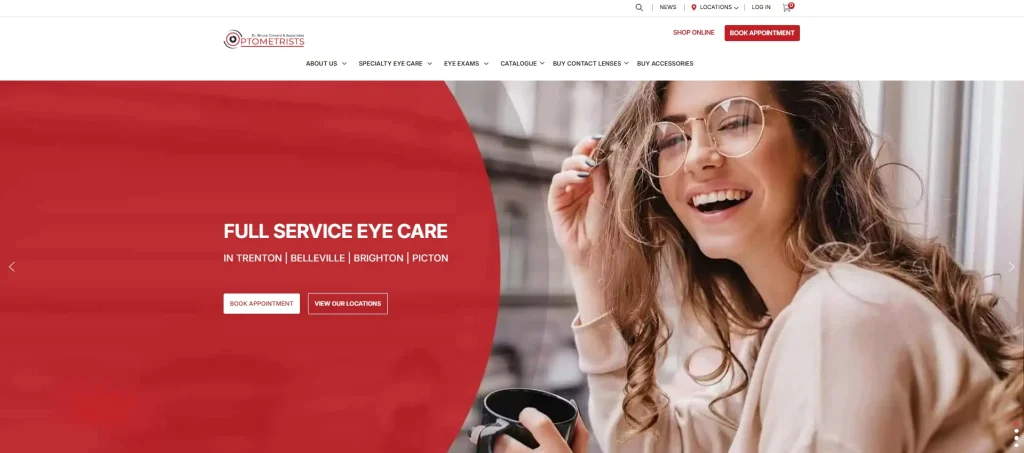
OptiCommerce practice websites typically follow this structure, with clearly defined service pages and a visible call to action. A good example is Dr. Bruce Coward & Associates, where patients can quickly understand services and move toward booking.
Make booking your primary CTA
“Book an appointment” should be the most prominent action across your site, particularly on mobile. It should appear naturally where patients are ready to decide in the main navigation, above the fold on key pages, and at logical moments throughout the content.
For mobile users, click-to-call is just as important. Some patients want immediate reassurance or have a quick question before booking, and removing friction at this stage can significantly increase conversions.
Prove trust fast
Visitors decide within seconds whether they trust a practice. Above the fold, your website should remove uncertainty before it has a chance to form.
This means reinforcing trust early by showing social proof through patient reviews, establishing credibility with clinicians or practice credentials, clearly explaining what happens during an appointment, and being transparent about insurance and payment options.
Well-placed Frequently Asked Questions (FAQs) can also address common questions upfront, reducing hesitation and helping patients feel confident enough to book.
2. Win Local Search with Google Business Profile Basics
Once your website can convert, the next priority is making sure local patients can find you where they search first. For most optometry-related queries, that starting point isn’t your homepage, it’s your Google Business Profile (GBP).
A well-maintained GBP often becomes the first impression of your practice, influencing whether a patient calls, requests directions, or clicks through to book.
Optimize core profile elements
Strong Google Business Profiles are built on clarity, completeness, and consistency, not just constant activity. At a minimum, your profile should use the correct primary and secondary categories, clearly list your services, and include up-to-date photos that reflect the real experience of your practice: from the exterior and interior to your team.
Regular posts help signal activity, while an actively managed Q&A section allows you to address common patient questions before they become barriers. Accuracy and freshness matter far more than volume, especially for local search visibility.
Build location relevance
Local search performance improves when Google can clearly connect your practice to a specific place. This goes beyond simply listing an address.
You can reinforce local relevance by using photos tied to your community, referencing neighbourhoods or service areas in your content, and ensuring your website’s location pages closely match your Google Business Profile details.
The stronger and more consistent these signals are, the more confident Google becomes in showing your practice to nearby searchers. Consistency across platforms strengthens both visibility and trust.
Track what matters
When reviewing Google Business Profile performance, focus on actions, not vanity metrics. Visibility only matters if it leads to patient behaviour that supports growth.
According to Google, Business Profile performance data shows how people discover your practice on Search and Maps, and what they do once they find you. This includes discovery signals (such as views) and intent-driven actions, like calls or direction requests. Reviewing this data over time helps reveal whether local visibility is translating into genuine patient demand.
The most meaningful Google Business Profile KPIs to track are:
- Calls generated directly from your profile
- Direction requests to your practice
- Website visits from Search and Maps
- Booked appointments that originate from local search traffic
Together, these metrics reflect real local intent, helping you move beyond visibility and understand how effectively your profile supports bookings.
3. Build a Review Workflow That Brings Trust
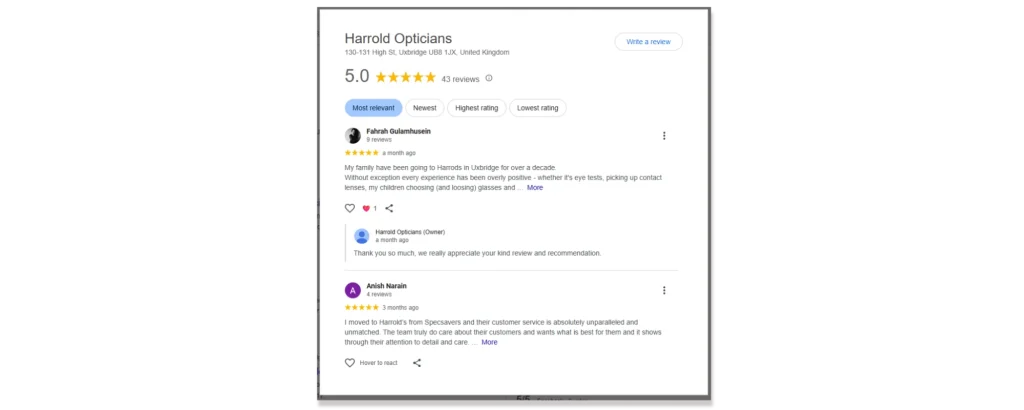
Local visibility is fragile without a strong reputation. In optometrist marketing, reviews are often the strongest form of proof a prospective patient sees before choosing a practice.
BrightLocal’s Local Consumer Review Survey found that 89% of consumers expect businesses to respond to all reviews, both positive and negative. This makes review management just as important as review collection.
Systemize review requests
Reviews should never be ad hoc. The most effective practices define a simple, repeatable process that removes effort for both staff and patients.
This starts with clarity around when reviews are requested, who initiates the request, and how easy it is for patients to leave feedback. Timing matters most: requests sent shortly after a successful appointment or eyewear collection consistently perform better than generic follow-ups. Consistency beats volume.
Respond consistently (and safely)
Responding to reviews shows customers you’re paying attention, and it protects your reputation in public. Prospective patients often read responses as carefully as the reviews themselves.
Replies should be prompt, professional, and neutral in tone, without referencing personal health details or appointment specifics. Even a short acknowledgement shows that your practice is engaged, attentive, and respectful of patient privacy.
Repurpose review themes into marketing
Reviews shouldn’t live only on Google. They are a rich source of language your patients already trust.
There are quite a few recurring themes in online reviews for opticians, such as friendly staff, clear explanations, fast turnaround, or strong frame selection. Look for those and reflect these messages back into your website copy, FAQs, and social proof assets. This reinforces credibility while keeping your messaging grounded in real patient experience.
4. Post Social Content that’s Structured (not Random)
Once search visibility and trust are in place, social media becomes a way to build ongoing familiarity with your practice. The goal isn’t to post constantly, but to follow a content rhythm your team can realistically maintain overtime.
Use a repeatable weekly mix
Social content works best when structure replaces guesswork. A simple, repeatable cadence keeps posting consistent without becoming a burden on the team.
A weekly mix might include educational content, frame styling or product highlights, behind-the-scenes moments, community involvement, and one clearly defined promotional post. Repeating this structure week to week reduces burnout, speeds up planning, and makes it easier to share responsibility across the team.
Make it local and human
Polished content has its place, but local relevance is what drives engagement. Staff spotlights, community partnerships, and real in-store moments consistently outperform generic stock imagery because they help patients recognise the people and environment they’ll encounter in person.
Tie posts to real actions
If you need inspiration, there are tons of optician social media content ideas. But, every social media post should have a clear purpose. Aligning content with patient intent helps turn engagement into outcomes.
- Awareness posts should encourage low-friction actions such as following or saving
- Consideration posts can prompt users to visit your website or send a message
- Conversion posts should make the next step obvious, such as booking an appointment or calling the practice
5. Use Short-Form Video to Multiply Reach
If social feels slow, short-form video is often the fastest way to earn attention when it’s templated and repeatable.
Start with proven prompts
Starting with proven prompts removes guesswork and speeds up content creation. Effective formats include:
- Frame try-ons
- Staff picks
- Myth vs fact
- Lens upgrades explained
- New arrivals showcases
These prompts lower creative friction and make it easier to post consistently.
Keep production simple
Short-form video performs best when production stays simple. Good lighting, a clear hook in the first two seconds, on-screen captions, and a consistent posting rhythm matter far more than polish or editing complexity.
Convert views into visits
Short-form video marketing for opticians is a good way to get better reach. But reach only matters if it leads somewhere. Every video should connect to a clear next step, whether that’s a booking page, a seasonal promotion, or an invitation to try frames in store.
Clear calls to action can help turn your short form videos into visits, and visits into appointments.
6. Use Email to Drive Recalls and Retention
New patient acquisition is expensive, but with the right optician email campaign strategies, you can get there. For independent optometry practices, retention is where growth becomes more predictable and sustainable. Email remains one of the most effective channels for maintaining that relationship over time.
Segment like an optometry practice
Email works best when messages reflect where patients are in their care cycle. Rather than treating your list as one audience, segment it based on clinical and purchasing behaviour.
Useful segments typically include exam-due patients, lapsed patients who haven’t visited in a defined period, contact lens wearers, and eyewear buyers. This level of segmentation allows you to send fewer emails, but make each one more relevant, improving engagement and response rates.
Build three core automations
Rather than relying on one-off campaigns, a small set of automated email sequences can do much of the heavy lifting in the background.
Every practice should have a welcome or new patient sequence that sets expectations and builds confidence, recall and reminder emails that prompt timely rebooking, and win-back or reactivation messages designed to re-engage patients who’ve drifted away. These automations ensure no patient journey is left to chance.
Run one revenue campaign per month
Automation supports retention, but planned campaigns support incremental revenue. A simple goal is to run one focused revenue-driving email campaign per month.
This might spotlight new frame arrivals, promote second pair offers, align with sunglasses season, support back-to-school eye exams, or highlight lens upgrades. Keeping campaigns intentional and limited prevents over-emailing while still creating regular opportunities for conversion.
7. Publish Service-Led Content that Earns Trust and Rankings
Once conversion and retention are in place, content becomes a compounding channel rather than a one-off tactic. Well-structured, service-led content builds trust over time, improves local search visibility, and reduces reliance on paid media.
Choose topics tied to patient intent
The most effective content starts with what patients are already trying to understand. High-performing topics in optometry typically include cost and pricing, what to expect before or during an appointment, common symptoms and when to seek care, comparisons between treatments or products, and localised content that references your city or service area.
Build FAQ sections from real questions
Your FAQ content shouldn’t be there for marketing purposes only, it should cover real questions you’ve heard over and over from your patients. Questions raised during front desk calls, social media messages, and appointment objections reveal where uncertainty exists. Turning these real questions into structured FAQ sections removes friction, improves on-page engagement, and supports both trust and search rankings.
Repurpose into social & email
Content delivers the most value when it doesn’t live in one place. One service-led blog post can be repurposed into five to eight social posts, each addressing a different question or angle, and a targeted email campaign that brings patients back to your site. This approach extends the lifespan of your content and increases ROI, while keeping messaging consistent across channels.
8. Run Paid Ads Only After you Fix the Journey
Paid media can accelerate growth, but only when it sends patients to a focused page with a clear next step. Without strong landing experience, ads tend to amplify inefficiencies rather than deliver bookings.
Use Google Search for high-intent services
Google Search is best suited to high-intent scenarios, where patients are actively looking for care. This includes exam bookings, urgent eye concerns, and core services. Targeting works best when ad copy is tightly aligned with the promise of the landing page. When the message in the ad matches what patients see after they click, friction is reduced and conversion rates improve.
Use social ads for awareness + retargeting
Social advertising plays a different role in the journey. Short-form video is effective for building awareness and familiarity, particularly among patients who aren’t actively searching yet. Once audiences are established, retargeting becomes the conversion lever. Showing specific offers to people who have already visited your site or engaged with your content consistently outperforms broad targeting, while keeping spend under control.
Measure the right outcomes
Paid campaigns should be judged by outcomes, not exposure. Likes, impressions, and views don’t indicate business impact on their own. The most meaningful metrics to track are:
- Cost per lead
- Cost per booking
- Show rate for booked appointments
These metrics reflect real patient intent and operational impact, helping you assess whether paid media is contributing to sustainable growth.
9. Add Optical eCommerce to Capture Demand Outside the Store
Once core marketing channels are working, eCommerce and omnichannel tools can help turn attention into additional eyewear revenue. For independent practices, this isn’t about replacing the in-store experience, but extending it digitally in a controlled, practice-led way.
Position your website as a digital shopfront
Your website can do more than simply inform. With integrated marketing tools for eyecare businesses from OptiCommerce, it becomes an interactive digital shopfront that combines website and eCommerce capabilities in one seamless experience. Practices can showcase frame collections, services, and brand identity together, rather than spreading them across disconnected pages or platforms.
This approach supports both visibility and engagement, allowing patients to explore eyewear online while keeping the journey anchored to professional, in-store care. OptiCommerce practice websites typically present frame collections alongside exam booking and in-store services, making it easy for patients to browse and take the next step.
Increase conversion with optical-specific tools
Optical-specific tools help reduce drop-off during the research phase. Features such as 3D virtual try-on and a frame fitter allow patients to visualise frames more confidently, removing friction for shoppers who aren’t ready to decide in-store yet.
Make online purchasing practical for optical
Practical eCommerce for optical requires workflows that reflect how practices actually operate. Online booking, secure payments via a payment gateway, and prescription-aware functionality help bridge online interest with in-store dispensing and care, rather than treating eyewear as a generic retail product.
Common Mistakes to Avoid
Even well-intentioned marketing can feel “broken” when a few common patterns creep in. Closing the loop means recognising where effort is being diluted or misdirected and fixing those issues before adding anything new.
Here are a few optician marketing mistakes to avoid:
Inconsistent effort across too many channels
Trying to be everywhere at once usually leads to scattered activity and inconsistent results. In practice, focusing on two or three core channels for a sustained period of around 90 days almost always outperforms spreading limited time and budget too thin. Consistency allows you to learn what works, refine your messaging, and build momentum. Constantly switching channels resets that progress and makes performance harder to judge.
Sending traffic to pages that don't convert
Even strong traffic will underperform if it lands on pages that lack clear direction. Without obvious calls to action, visible trust signals, and basic tracking in place, it becomes difficult for patients to take the next step or for practices to understand what is working. Effective marketing depends as much on where you send people as how you attract them.
Conclusion
Optometrist marketing is most effective when it operates as a connected workflow, not a set of disconnected tactics: getting found locally through search and reviews, converting on-site through clear services and booking paths, and retaining patients through email and recall activity.
Practices don’t need to do everything at once. The priority is focus. Implement these nine ideas in order, track a small set of KPIs tied directly to bookings and eyewear sales, and build momentum before adding new channels or tools.
As practices mature beyond basic marketing, OptiCommerce supports the website and eCommerce layer, helping ensure that online visibility translates into measurable appointments and eyewear sales. A simple next step: choose two ideas to implement in the next 30 days, and assign a clear owner and success metric for each.