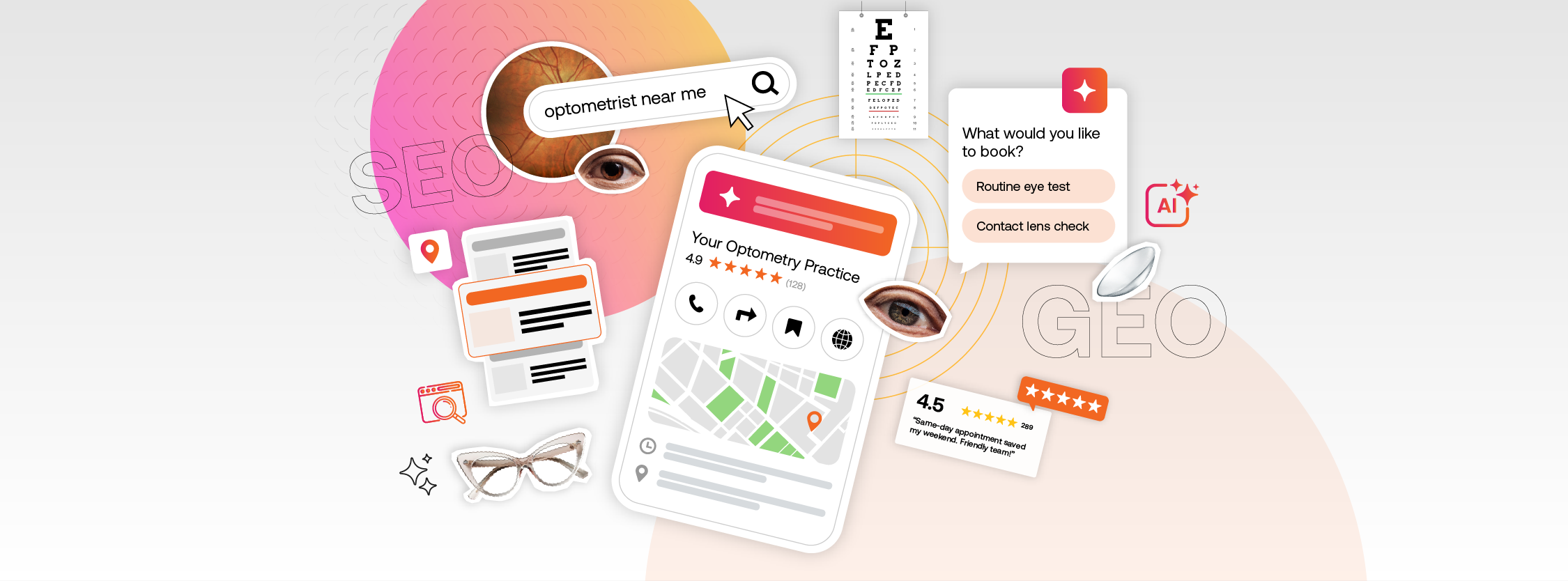
Patients now don’t just Google your optical practice anymore. Some of them ask AI search engines“find me a good optometrist near me”, and search engines show them results within seconds. And if your practice isn’t mentioned in that answer, patients never see you at all.
This is where Generative Engine Optimization (GEO) comes in: your strategy should focus on how to get cited, outrank competitors, and show up in those results when a patient searches for your service or product.
This article covers what’s actually changed and what you can check today in terms of your optical business presence to improve its AI visibility.
What is AI SEO for Your Optical Practice?
The simple answer is AI SEO is the ongoing work of shaping how AI tools such as ChatGPT, Google’s AI Overviews, and Perplexity read, verify and cite information about your business. So that when patients search for your services or products you offer, your name comes back among the top answers.
Unlike traditional SEO for optometrists, where a patient searches and Google shows a map with a few local listings, the AI-assisted search works differently. When a patient asks a question on ChatGPT or another AI tool, the AI system generates a short, direct answer listing several optical practices. There is no list to search or a second page to check. You are either in that answer or not.
The important thing is to understand that ranking higher in traditional search doesn’t mean automatically being recommended by AI tools. Keep reading to find out why.
How an AI Assistant Actually Decides Who to Recommend
AI search tools don’t know everything about your eyecare business. They gather information from different sources online and use it to provide an answer. The information that matters the most includes:
Your Google Business Profile
Google Business Profile (GBP) is one of the most important sources for local recommendations. Keep your GBP complete, up to date and accurate. The more complete and trustworthy your profile is, the easier it will be for AI search engines to understand your practice and recommend it. Therefore, make sure your practice name, address, phone number, opening hours, website, services and images are all correct.
Website Consistency Online
AI systems cross-check your business name, address, and phone number against Google, your website, Bing Places, Apple Business Connect, social media profiles, online directories, and other online sources. Make sure all important details about you are consistent wherever your practice appears online.
Third-Party Mentions
Online reviews, local news articles, directory listings, and professional association pages can all help build trust. When your optical practice is mentioned on other websites, AI tools see this as additional proof that your practice is real, established, and trusted.
Helpful, Expert Content
AI tools favour helpful, educational content that is written or reviewed by experts and provides real value to patients. Focus on answering the questions and concerns your patients commonly have, such as: “How often should I have an eye exam?”, “What is the difference between single-vision and progressive lenses?” or “How to prepare for an eye exam?”
Create content from a unique perspective that shows your expertise. Share practical advice, explain things clearly, and include insights based on your professional experience.
How AI SEO Works for Your Optometry Practice
The basics of AI SEO apply to any local business, but optometry has a few key considerations.
- The services you offer. “Optometrist” can mean different things, including eye exams, contact lens fitting, children’s eyecare, dry eye treatment, and diabetic eye exams. If a patient asks an AI assistant, “Who does contact lens fittings near me?” it needs to find clear information showing that you offer this service. Create a page or section for each of your main services instead of putting everything into one long list.
- Make your payment and funding information easy to find. Patients often ask questions like “Does this optometrist accept my insurance?” or “Am I eligible for a free NHS eye test?”. If this information is only available by phone or hidden in a PDF, AI may not be able to find the answer. A simple page outlining accepted insurance plans, NHS eligibility, or payment options makes this much easier to find.
- Answer specific patient needs. Patients don’t always search for a general “eye doctor.” They may look for a same-day appointment, a walk-in optometrist, or an eye doctor for their child. Creating content that answers these specific needs can help AI understand when your practice is a good match.
- Show your clinical expertise. Choosing an eyecare provider is a healthcare decision, so patients want to know they can trust you. Include your optometrists’ qualifications, specialities, and the treatments you provide on your website.
A Quick Way to See Where Your Practice Stands
If you want to know whether AI engines are recommending your practice, there are several ways to do that, including:
- Confirm your business profile is complete and accurate.
- Ask a free AI assistant a question your patient would actually ask, such as “best optometrist in [your town]”, “optometrist near me”, or “a same-day eye exam”. Try it with different tools (ChatGPT, Perplexity, AI Overview) since they pull data from different sources.
- Check whether your name, address, and phone number are consistent across your website and every online directory you appear on.
- Search your practice name in quotes to see what’s actually being said about you across the web, beyond your own site.
Or, if you’d rather skip the manual checking, OptiCommerce’s free AI Digital Audit does it for you. It scans your practice’s online presence across these exact sources and shows you where the gaps are. You can request your free AI Digital Audit here.
If you don’t show up, or the information that comes back is outdated, you’ve just found your starting point.
What Does This Mean for Your Practice
While some patients will still use traditional search, others may get the answer directly from an AI assistant and call your practice without ever visiting your website. So, a drop in your traffic doesn’t mean that fewer patients are finding you.
Also, traditional SEO still plays a role in your online presence. Strong patient reviews, a clear website, accurate content, strong internal linking strategy still matter. If Google can’t crawl your page due to technical issues, AI crawlers will struggle to access your page and your content too.
Like traditional SEO, AI SEO for optical practices isn’t a one-time job. Different AI tools use different sources and update their information on different timelines. It’s worth checking your visibility periodically rather than doing it once and forgetting about it.
Where to Go from Here
The way patients discover a practice is changing faster than most practice owners have had time to notice. The good news is that none of this requires starting over. It’s mostly about making sure the information already out there about your practice is accurate, consistent, and easy for AI tools to understand.
Start with the basics and consistently track your AI visibility. Think of it as an extension of the work you’re already doing to make your practice visible, credible, and helpful online.
Claim your free AI Digital Audit and find the right solution to help your optical business stay ready for patient discovery.