
Eyefinity is one of the more established names in U.S. optometry software. It covers the core workflows most practices need: scheduling, EHR, billing, and lab integrations, and it has a long enough track record that it tends to come up early in any serious software search.
Some practices find it fits well and stay for years. Others, as their needs shift, start wondering whether a platform they chose early in their growth is still the right one.
This article looks at where Eyefinity works well, where it doesn’t, and which alternatives are worth putting next to it for a direct comparison, without declaring a winner or pushing any single vendor.
Is Eyefinity the Right Long-Term Fit?
A few patterns come up repeatedly when practices start looking around.
For some, the trigger is billing. Eyefinity’s tight Vision Service Plan (VSP) integration is useful if VSP dominates your claims, but practices running a broader payer mix often find the platform doesn’t handle other insurers with the same fluency, and over time, that friction adds up.
For others, it’s the dispensary. Practices that have grown their optical retail operation find that Eyefinity’s ordering and lab tools cover the basics, but fall short when the dispensary needs real POS functionality: promotions, inter-branch inventory, workflows. It’s an EHR that includes some retail features, not a retail system that also does EHR.
And for a fair number of practices, there’s no specific pain point. They’ve been on Eyefinity for a long time, it works well enough, but a renewal or an expansion is prompting them to check whether better options exist before committing again.
Where Eyefinity Fits Today
Eyefinity is a cloud-based practice management and EHR platform built for optometry, with deep roots in the VSP network. Core capabilities include scheduling, billing and insurance claims, EHR charting, lab and ordering integrations, and patient communication tools.
A few recurring themes come up when practices start comparing alternatives:
- VSP dependency: The tight VSP integration is a genuine strength for the right practice, but it’s less of an advantage (and occasionally a constraint) for practices with a more varied payer mix.
- Optical retail depth: Order entry and lab connections are solid, but practices running high-volume dispensaries or wanting detailed POS and promotions tools sometimes find this side of the platform less developed than they need.
- Pricing visibility: Pricing is quote-based, which makes early-stage budgeting harder. The full cost (once modules, users, and implementation are factored in) can land quite differently from initial expectations.
None of these are automatic deal-breakers. For a VSP-heavy U.S. optometry practice, Eyefinity remains a sensible choice. But they’re worth testing directly before committing.

Note: Features, integrations, and fit vary by practice type, region, and configuration. Confirm details directly with vendors before shortlisting.
| Product | Best for (practice type) | Clinical focus | Optical / POS strength | Multi-location support | Pricing model |
|---|---|---|---|---|---|
| Eyefinity | U.S. optometry practices with strong VSP billing workflows | Integrated optometry EHR + PM | Optical order entry and lab integrations; retail tools present but not POS-first | Yes — multi-location enterprise support | Quote-based subscription |
| RevolutionEHR | U.S. independents and small-to-mid groups wanting all-in-one EHR + PM | Full optometry EHR + charting + PM | Optical/ordering tools included; retail less deep than dedicated POS systems | Yes — cloud multi-site visibility | Subscription per provider; quote-based |
| Crystal PM | U.S. practices spanning optometry and ophthalmology in one platform | Optometry + ophthalmology EHR with PM | Optical tools and major lab integrations included | Multi-location available | Subscription; quote-based |
| MaximEyes | Established U.S. independents wanting a proven EHR + PM with flexible deployment | Full optometry EHR + PM | Optical dispensing and inventory tools included | Multi-location available | Subscription or perpetual licence; quote-based |
| Optix | UK and Ireland independents and multi-site optical practices | PM with patient records, scheduling, stock | Strong dispensing, POS, stock and supplier workflows | Multi-branch support in UK market | Subscription per site; quote-based |
| Acuitas 3 | Optical chains and multi-location practices where retail and POS are central | PM + optical/retail + clinical workflows | Strong POS, inventory, analytics; built for optical-centric operations | Yes — designed for multi-site and omnichannel | Quote-based by size and modules |
Eyefinity
Best for: U.S. optometry practices with significant VSP billing volume, or practices already inside the Eyefinity ecosystem looking for a connected scheduling, EHR, and claims environment.
Key strengths:
- Deep VSP billing integration with streamlined insurance claims workflows
- Scheduling, EHR, and practice management in one connected environment
- Cloud-based with multi-location visibility
- Patient portal and communication features built in
- Lab and ordering integrations included
May not be ideal if:
- Your payer mix extends well beyond VSP and you want a more carrier-neutral platform
- Advanced optical retail, promotions management, or POS-first workflows are a priority
- You prefer publicly listed pricing before entering vendor conversations
Pricing: Subscription-based; quote-driven depending on features, users, and scale.
RevolutionEHR
Best for: RevolutionEHR works best for independent optometry practices and small-to-mid-sized groups in the U.S. wanting a dedicated optometry EHR and practice management platform that isn’t tied to a specific insurance network.
Key strengths:
- Integrated optometry EHR, billing, and scheduling in a single system
- Cloud-based access from any device, with multi-location visibility
- Built-in patient communication and recall tools
- Optical ordering and inventory tools included
- Designed specifically for optometry workflows from the ground up
May not be ideal if:
- Your practice runs a high-volume dispensary and needs advanced POS, promotions management, or inter-branch inventory control
- You want transparent public pricing before getting into vendor conversations
- You’re a stable single-site practice with straightforward optical retail needs and no near-term plans to expand
Pricing: Subscription-based, starting from around $319/month for the Core plan. Advanced and Premium tiers available at higher price points. Exact pricing varies by number of providers, add-ons, and practice size.
Crystal PM
Best for: U.S. practices that need optometry and ophthalmology covered within a single platform, without managing two separate clinical systems.
Key strengths:
- Covers both optometry and ophthalmology in one environment (practical if your practice spans both)
- Integrated EHR, scheduling, billing, and optical dispensing tools
- Direct connections to major optical labs and suppliers
- Patient communication and recall functionality included
- Cloud-based with multi-location support
May not be ideal if:
- Your primary need is a retail-first or high-volume POS environment
- You want detailed public pricing before speaking with the vendor
- You’re outside the U.S. market
Pricing: Subscription-based; quote-driven based on practice size, users, and modules.
MaximEyes
Best for: Established U.S. optometry independents that want a full-featured EHR and practice management system with a long track record, and the option to choose between cloud and on-premise deployment.
Key strengths:
- Full optometry EHR with clinical charting, billing, and practice management
- Optical dispensing and inventory tools included
- Flexible deployment: cloud-based or on-premise depending on preference
- Patient communication and scheduling tools built in
- Strong track record with independent U.S. optometry practices
May not be ideal if:
- You need advanced multi-location retail workflows or complex POS and promotions management
- You’re looking for a platform with heavy recent investment in product development and a modern UI
- You’re outside the U.S. or need specific international compliance features
Pricing: Subscription or perpetual licence options available; quote-based depending on deployment model, users, and modules.
Optix
Best for: UK and Ireland independent opticians and multi-site optical practices that want integrated diary management, patient records, and retail workflows in one system.
Key strengths:
- Strong UK market fit with relevant supplier integrations
- Integrated dispensing and stock control
- Multi-branch visibility and reporting
- Designed with optical-business workflows as the starting point, not bolted on
May not be ideal if:
- Your practice is outside the UK or Ireland
- You need specialist ophthalmology or surgical EHR capabilities
- You’re running a large enterprise chain that requires deeper omnichannel retail functionality
Pricing: Subscription model, typically per site or configuration; quote-based.
Acuitas 3 (Ocuco)
Best for: Independent practices and groups where optical retail performance, multi-location visibility, and omnichannel capability are central to the decision; and who may run a separate ophthalmology EHR for the clinical side if needed.
Key strengths:
- Strong optical retail and POS: inventory control, pricing rules, promotions, and insurance benefit handling
- Stock visibility and control across locations with Acuitas 3 for chains
- Practice management tools covering booking, recalls, patient communications, CRM/marketing, and reporting
- Designed for growing chains and independents that want a unified retail and patient management system
- Supports omnichannel workflows where online and in-store operations need to work together
May not be ideal if:
- You need a stand-alone ophthalmology surgical EHR as your primary clinical record
- You prefer a fixed public price list before speaking to a vendor
- You’re a stable single-site practice with straightforward optical retail needs and no near-term plans to expand
Pricing: Quote-based; varies by number of locations, users, and modules selected.
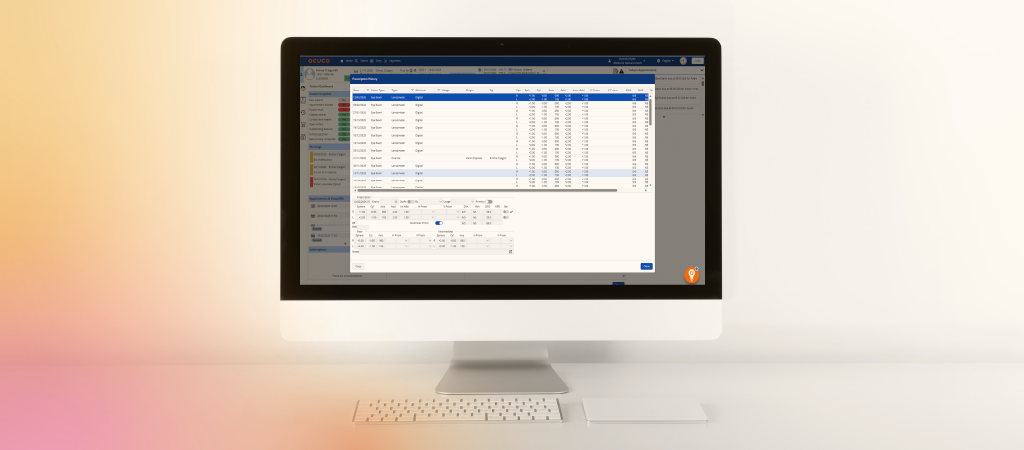
Acuitas 3 EHR system – Prescription dashboard
From Comparison to Commitment: A Practical Approach
Finding the best software for optometrists can drag on too long because practices start with demos instead of decisions. You end up sitting through four or five product tours before you’ve agreed internally on what you actually need with no final decision in sight.
A better sequence is to front-load the internal work.
Know Your Non-Negotiables Before You Talk to Anyone
Two questions will cut your shortlist faster than any feature list. First: how reliant are you on VSP, and do you want that to stay the same? If VSP makes up the bulk of your billing, that narrows the field quickly. If you’re deliberately broadening your payer mix, it narrows it in a different direction.
Second: is optical retail a core part of your revenue, or a supporting function? Practices where the dispensary drives significant income need to evaluate POS and inventory tools as seriously as EHR features, and most EHR-first platforms won’t hold up to that scrutiny.
Once you’ve answered those, layer in the practical constraints: number of locations, existing systems you’re not replacing, implementation budget, and how much downtime your team can realistically absorb during a transition.
Structure Your Demos So You Can Actually Compare
Take the same list of questions into every demo. Ask vendors to show you real workflows: insurance billing with a non-VSP plan, a frame sale with a discount applied, and a multi-location stock query, rather than letting them run a scripted tour.
Ask directly about data migration, what the first 90 days look like, and what support looks like after go-live.
Then compare total cost over two to three years, not just the monthly figure. Implementation fees, training, and add-on modules rarely show up in the first conversation.
If your practice runs a high-volume dispensary or manages stock across multiple locations, Acuitas 3 is worth including in your demo shortlist. It’s built specifically around optical retail and multi-site operations, not as a feature added onto an EHR, but as the core of how the system is designed.